
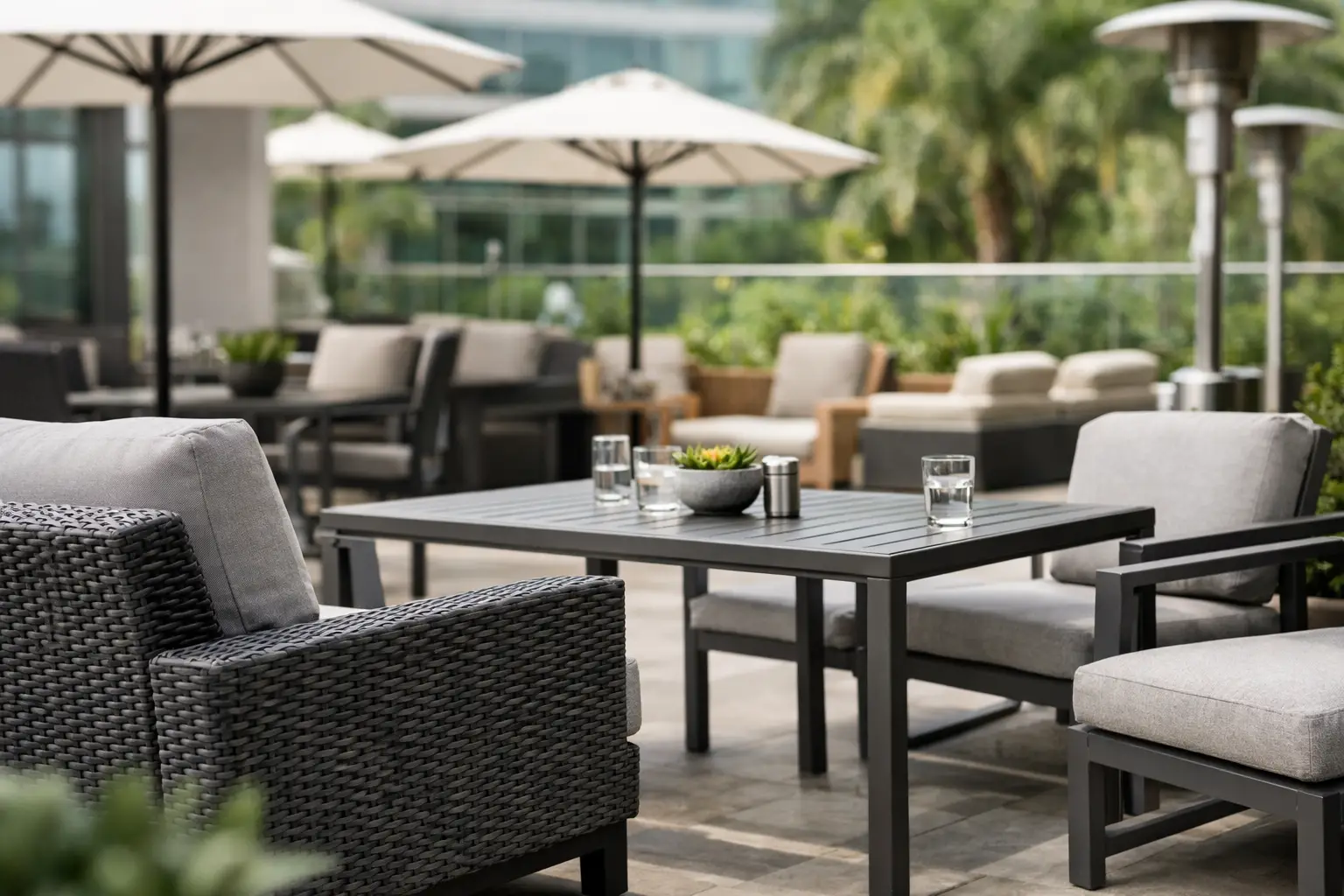
A rooftop lounge can look flawless on install day and still fail six months later. The difference usually is not styling. It is specification.
For hotels, restaurants, developers, and procurement teams, the real question is not whether a chair looks right in the render. It is what makes outdoor furniture commercial grade once it faces UV exposure, pool chemicals, heavy turnover, frequent cleaning, and constant use. Commercial grade is a performance standard first. Design only works when the build can keep up.
What makes outdoor furniture commercial grade
Commercial-grade outdoor furniture is built for repeated, high-traffic use in exposed environments. That means stronger internal construction, more stable materials, tighter quality control, and finishes designed to resist weather, corrosion, fading, and wear over time.
Residential outdoor furniture may look similar at first glance, but the engineering priorities are different. A private patio sees lighter use, gentler cleaning, and fewer liability concerns. A hospitality terrace, pool deck, or restaurant patio needs furniture that performs under load, stacks or moves efficiently when required, and maintains its finish through daily operations.
This is why commercial grade is rarely defined by one material alone. Teak, aluminum, rope, resin, sling, and upholstery can all be used in commercial settings if the full product specification is right. Frame wall thickness, weld quality, joinery, coating process, fabric rating, hardware selection, and testing standards matter more than surface appearance.
Frame strength is where performance starts
If you want to know what makes outdoor furniture commercial grade, start with the frame. This is where long-term durability is won or lost.
Commercial frames are engineered to handle frequent sitting, shifting, dragging, stacking, and cleaning. In practice, that often means heavier-gauge aluminum, stainless steel in the right applications, reinforced stress points, and welds that can withstand repeated loading without loosening. On dining chairs and loungers especially, weak joints show up quickly in operational environments.
Aluminum remains a leading choice because it is lightweight, corrosion resistant, and practical for hospitality teams that need to reconfigure layouts. But not all aluminum furniture is commercial grade. Alloy selection, tube thickness, weld consistency, and pretreatment all affect whether the product is suitable for long-term contract use.
Wood has its place as well, particularly in luxury hospitality and residential-commercial crossover settings. But for wood to perform commercially, species selection, moisture control, joinery, and finishing must be managed correctly. A beautiful timber chair with poor construction will still fail under commercial turnover.
Finishes need to survive operations, not just weather
Outdoor exposure gets most of the attention, but daily operations are just as demanding. Commercial furniture is wiped down constantly, moved by staff, and exposed to sunscreen, spilled drinks, food acids, chlorine, and general abrasion.
That is why finish systems matter. Powder coating is common on metal frames because it offers good resistance to chipping, UV exposure, and corrosion when applied correctly. The key phrase is when applied correctly. Pretreatment, coating thickness, curing, and adhesion all affect real-world performance. A poor finish specification can turn a good frame into a maintenance problem.
In marine, coastal, and poolside environments, the finish requirement becomes even stricter. Salt air, humidity, and chemical exposure accelerate corrosion. That does not mean every project needs the same finish system. It means the material and coating should match the site conditions from the beginning.
For procurement teams, this is one of the biggest commercial-grade checkpoints. Furniture should be selected by environment, not just by collection aesthetic.
Outdoor fabrics and cushions have to work harder
Cushioned seating is often where projects drift into under-specification. The silhouette may be right, but foam, fabric, and internal construction are what determine how the piece performs after opening.
Commercial-grade outdoor cushions are designed for UV resistance, moisture management, shape retention, and frequent cleaning. Fabrics should resist fading and mildew. Foam should dry appropriately for the application and recover after repeated use. Seams, zippers, and thread also matter, especially in hot climates and high-use hospitality settings.
There is always a trade-off here. Plush residential-style cushions can feel appealing in a showroom, but if they retain water, flatten quickly, or require excessive maintenance, they are not right for a busy resort or restaurant. The better specification balances comfort, dry time, durability, and upkeep.
This is especially relevant for pool loungers, cabanas, and deep seating, where guest experience is important but operational practicality cannot be ignored.
Testing, compliance, and load performance matter
Commercial grade is not just a marketing term. It should be backed by product testing, engineering logic, and manufacturing discipline.
Depending on the category, commercial outdoor furniture may be evaluated for static load, impact resistance, stability, fatigue, and finish performance. These tests help confirm that a chair, table, or lounger can handle repeated use without premature failure. In a commercial setting, that is not just about lifespan. It is also about safety, brand standards, and replacement cost.
The level of testing required depends on the project. A cafe terrace has different demands than a luxury hotel pool deck or a furnished multifamily rooftop. That is why experienced buyers do not ask only what the product is made from. They ask how it has been built, how it has been tested, and whether the supplier can support the specification with documentation.
Commercial grade also means consistency at scale
One chair that performs well is useful. Two hundred chairs delivered across multiple sites with the same finish, dimensions, and build quality is what commercial buyers actually need.
This is where many sourcing programs run into trouble. Even a strong product design can become risky if the supplier lacks production control, finish consistency, or the ability to manage timelines. Commercial grade is not just a feature of the furniture. It is a feature of the supply chain behind it.
For architects, developers, and hospitality operators, consistency matters because projects are specified at scale. Replacement planning matters. Mock-up approvals matter. Material swatches matter. If a supplier cannot maintain finish uniformity, lead-time discipline, and repeatability across production runs, the procurement risk rises fast.
That is why vertically integrated manufacturing has real value in commercial outdoor programs. Design control, production oversight, and logistics coordination reduce the gaps that often lead to substitutions, delays, or mismatched product in the field.
What makes outdoor furniture commercial grade in different categories
The answer changes slightly by product type because each category faces different stress.
Lounge seating needs frame integrity, cushion performance, and finish durability, especially where guests linger for long periods. Dining furniture is exposed to constant movement, high turnover, and frequent cleaning, so stability and surface durability are critical. Poolside furniture needs to handle water, UV, chemicals, and repositioning by staff throughout the day. Shade structures and accessories add another layer, where hardware, anchoring, and environmental exposure become central to the specification.
A commercial-grade outdoor table, for example, is not judged the same way as a sun lounger. Tabletops must resist scratching, staining, and heat exposure. Loungers must manage moisture, mobility, and occupant load. The material story changes by category, but the standard stays the same: the product must be built around sustained commercial use.
Design flexibility is part of the commercial-grade equation
Commercial buyers are not choosing between performance and appearance. They need both.
That is why the best contract-grade programs offer material flexibility, finish options, and customization without losing control over lead times or quality. A developer may need one look for a rooftop bar and another for villa terraces, while keeping procurement centralized. A hotel operator may want branded fabrics or tailored dimensions that still align with maintenance realities.
This is where supplier capability becomes part of product quality. When design consultation, 3D drawings, mock-up approvals, and manufacturing coordination are handled within one system, specification errors go down. Projects move faster because decisions are based on real material options, not assumptions.
At PNZ Space, this approach supports buyers who need commercial outdoor furniture that is design-led but operationally proven, from concept through delivery.
How buyers should evaluate a supplier
If you are comparing vendors, ask practical questions. What is the frame material and thickness? What finish process is used? What fabrics and foam constructions are available? Has the product been tested for commercial use? Can the supplier support custom finishes, mock-ups, and volume delivery? What happens if you need matching replenishment later?
A good supplier should answer clearly and without overcomplicating the specification. Commercial buyers do not need vague claims about premium quality. They need evidence of manufacturing control, dependable timelines, and project support that fits the scale of the job.
That is the real standard behind commercial grade. It is not a label added at the end. It is built into the product, the process, and the supplier’s ability to deliver consistently.
When outdoor furniture is specified correctly, it does more than hold up outside. It protects the guest experience, reduces replacement cycles, and gives project teams one less thing to fix after opening.
