
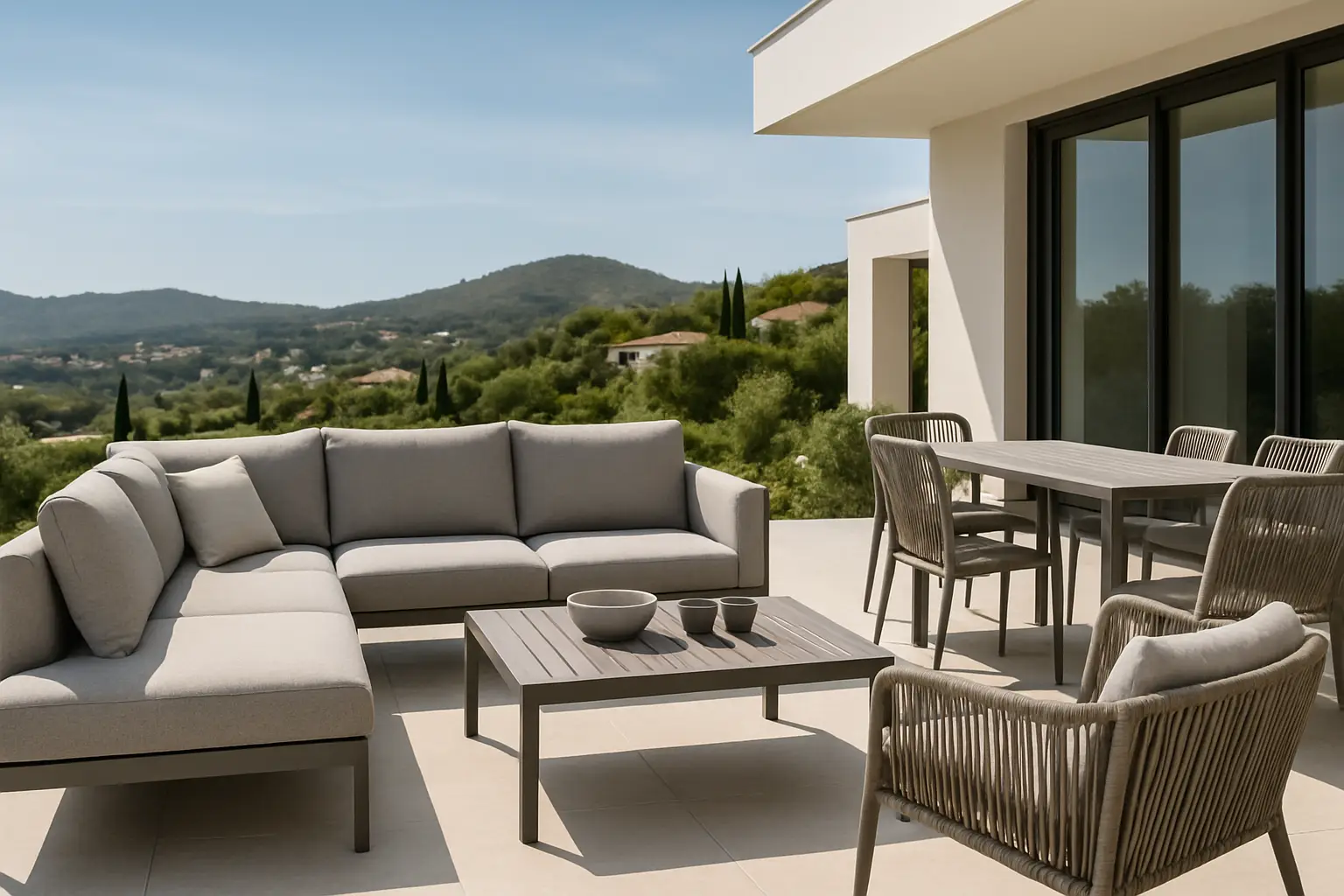
A villa terrace can look flawless at 10 a.m. and fall apart by the next season. Not because the design was wrong, but because the furniture was specified like an indoor set – light on structure, vague on materials, and optimistic about maintenance. If you are furnishing villas at scale or managing a high-visibility property, “modern” is not a style alone. It is a performance standard: clean lines, consistent finishes, and contract-grade durability that holds up to heat, UV, salt air, and heavy use.
What “modern” really means in villa outdoor spaces
Modern outdoor furniture earns the label when it supports architectural clarity and makes the site feel intentional. You see it in low-profile silhouettes, generous proportions, and restrained detailing. You also see it in planning: circulation is clean, zones are defined, and every piece has a reason to exist.
For villas, modern usually needs to do more than look minimal. It has to coordinate across multiple settings that share the same language – pool deck, main terrace, balcony off the primary suite, and a garden lounge that is used differently at night than it is during the day. The trade-off is that a highly edited look leaves less room to hide mismatched textures, drifting colors, or inconsistent seat heights. Modern reads as “off” faster when specification control is loose.
The four villa zones that drive your specifications
Most villa outdoor projects can be organized into four zones: lounge, dining, poolside, and shade plus accessories. Treating them as a system helps procurement, because you can align materials, frame colors, and fabric stories across the full property rather than solving each area as a one-off.
Lounge: where comfort and scale get tested
Outdoor lounge seating is the first place owners and guests notice shortcuts. Modern lounge sets often look simple, which means cushion quality and frame geometry do the heavy lifting.
Seat depth should match the intended use. Deep lounge is right for relaxed conversation and longer dwell time, but it can read too casual near formal architecture or in tighter courtyards. Upright lounge plays better for hosting, especially when you need guests to get in and out easily.
Cushion construction is not a detail to gloss over. High-density foam with proper wrap and drainage design matters in humid climates and near pools. If the project expects frequent turnover or rental use, consider cushion systems that are easy to remove, store, and replace without custom rework each time.
Dining: precision matters more than softness
Modern villa dining is about crisp edges, stable bases, and consistent chair ergonomics across long tables. The most common failure mode is wobble – not dramatic, just enough to feel cheap. That is a structural spec issue: base design, fasteners, and how the table is engineered for expansion and leveling.
Think about chair stackability early. In many villas, dining layouts flex for events, and the ability to stack or store extra chairs reduces wear and simplifies operations. The trade-off is aesthetic: some of the sleekest silhouettes are not designed to stack. Decide what matters more for that property.
Poolside: the harshest test environment
If you want a fast way to validate “contract-grade,” evaluate the chaise lounge. Poolside pieces live in full sun, get dragged across pavers, and take chemical exposure from sunscreen and water treatment.
Modern poolside furniture should be specified with heat management in mind. Dark metal finishes can become uncomfortable in direct sun, while certain synthetics hold heat differently than expected. Sling systems can dry quickly and reduce cushion storage needs, but they change the comfort profile. Cushioned chaises are premium, yet they require a clear plan for drainage, drying, and storage during storms or off-season.
Shade and accessories: the difference between staged and finished
Shade solutions and accessories are where a villa moves from “furnished” to “operational.” Umbrellas, pergolas, side tables, outdoor rugs, and storage are not decorative add-ons. They solve real issues: glare control, surface protection, and where to put towels, drinks, or a phone without balancing it on a cushion.
The modern approach is restraint with consistency. Use a tight finish palette and repeat shapes. One well-specified umbrella style used across zones can look more premium than three unrelated shade products.
Material choices that hold up and still look modern
Villa projects often sit at the intersection of design ambition and environmental reality. Material selection is where that tension gets resolved.
Powder-coated aluminum is a modern standard because it is lightweight, corrosion-resistant, and easy to specify in consistent colors across a full program. The variable is coating quality and prep. In coastal environments, you want confidence in surface preparation and coating thickness, because failures show up as chips and creeping corrosion at joints.
Stainless steel can be beautiful and architectural, especially for sharper modern lines, but grade and environment matter. In salt air, incorrect stainless selection becomes a maintenance story. If the owner expects minimal upkeep, aluminum often delivers a better lifecycle experience.
Teak and other hardwoods bring warmth to modern outdoor furniture for villas, particularly when the architecture is stone-heavy or minimalist. The trade-off is finish expectation. If the owner wants teak to stay “new,” that is a maintenance plan, not a product claim. If they accept natural silvering, teak is one of the most forgiving materials for exterior use.
All-weather wicker and rope can read modern when the weave is tight and the profile is clean. These materials are also useful for softening large hardscape areas. The risk is visual noise: overly textured weaves can fight modern architecture. Sampling the actual weave and color in site lighting prevents expensive surprises.
For tabletops, sintered stone and high-performance ceramic surfaces deliver a premium modern look with strong scratch and heat resistance. Glass can be clean and minimal but shows fingerprints and can feel cold next to warm materials like wood. For high-traffic hospitality-style villas, prioritize surfaces that tolerate cleaning chemicals and daily use without babying.
Fabrics and finishes: where “modern” often fails
Modern outdoor schemes live or die by fabric choice. A beautiful neutral can skew green in shade, pink in sunset light, and dirty after one season if the fiber and finish were not right.
Solution-dyed acrylics and performance textiles designed for outdoor use are the baseline. Beyond fiber, look at stitch quality, zipper selection, and whether the cushion design supports airflow and drainage. In high-sun regions, UV performance is not optional. In high-dust environments, you want fabrics that clean without leaving water rings or requiring specialty care.
Color strategy should be intentional. Modern villas often lean tonal – sand, stone, warm gray – with one controlled accent. The more neutral the palette, the more important it is to keep whites consistent across categories. “White” in rope, upholstery, and powder coat are rarely the same white unless you control the full specification.
Specifying for procurement: how to reduce rework and delays
Modern outdoor furniture for villas becomes complicated when it is treated as a shopping exercise instead of a procurement plan. Rework usually comes from three avoidable gaps: incomplete dimensions, unclear finish intent, and late-stage substitutions.
Start by locking the layout with real footprints. Outdoor lounge sets often look compact in photos but occupy more space once you include circulation and side tables. Confirm clearances around chaises, dining pull-back space, and door swings.
Next, standardize your finish schedule. Choose a primary frame finish, a secondary accent finish, and a fabric family that can span lounge and dining seating. This is how you maintain modern consistency across multiple villa zones while still giving each area its own identity.
Finally, plan for approvals the same way you plan for installation. Swatches, mock-ups, and a clear bill of materials prevent the “almost matching” problem that shows up when pieces arrive from different production batches or different vendors.
This is where a vertically integrated supplier earns its place. When design, manufacturing, and logistics are controlled under one operating system, you get tighter consistency, fewer handoffs, and clearer accountability for timelines.
When customization is worth it (and when it is not)
Customization is powerful for villas because it can solve site-specific problems: a sectional that fits a narrow terrace, a dining table length that aligns with a view axis, or a shade solution that clears a parapet line.
It is not always the right move for every line item. Customizing core anchor pieces can deliver real impact, while using proven standard products for side tables, occasional chairs, or accessories can protect lead times and simplify replacement.
A practical rule: customize what sets the visual language and what cannot be easily swapped later. Keep the rest standardized so operations stay manageable.
Project support that actually moves the job forward
For B2B buyers, the furniture is only half the deliverable. The other half is execution: drawings, approvals, packaging, delivery sequencing, and installation readiness.
If you are furnishing multiple villas or a villa community, ask early about 3D drawings, mock-up approvals, material sampling, and SKU continuity. You want to avoid a scenario where phase one looks perfect and phase two arrives with a slightly different frame sheen or fabric hand.
At PNZ International, we see the best outcomes when the outdoor package is treated like a real scope with drawings, finish control, mock-ups, and white-glove logistics built into the plan – not as an afterthought once construction is wrapping.
The closing thought to keep in mind: modern outdoor furniture is not “less.” It is fewer decisions made with more discipline – and that discipline shows up most clearly after the first hard season, when the villa still looks as sharp as the renderings promised.
