
Shade failures rarely look dramatic on drawings. When planning your outdoor spaces, it’s important to consider Cantilever vs Center Pole Umbrellas for Projects to avoid issues like a dining table that can’t be fully used at noon, a pool deck where loungers keep getting dragged to chase coverage, or a café terrace where the pole lands exactly where service needs to flow.
That’s why the cantilever umbrella vs center pole decision is less about style and more about layout control, wind behavior, and how your team plans to operate the space day after day. For hospitality and multi-unit residential work, you’re not just buying shade. You’re buying predictability.
Cantilever umbrella vs center pole: what actually changes on site
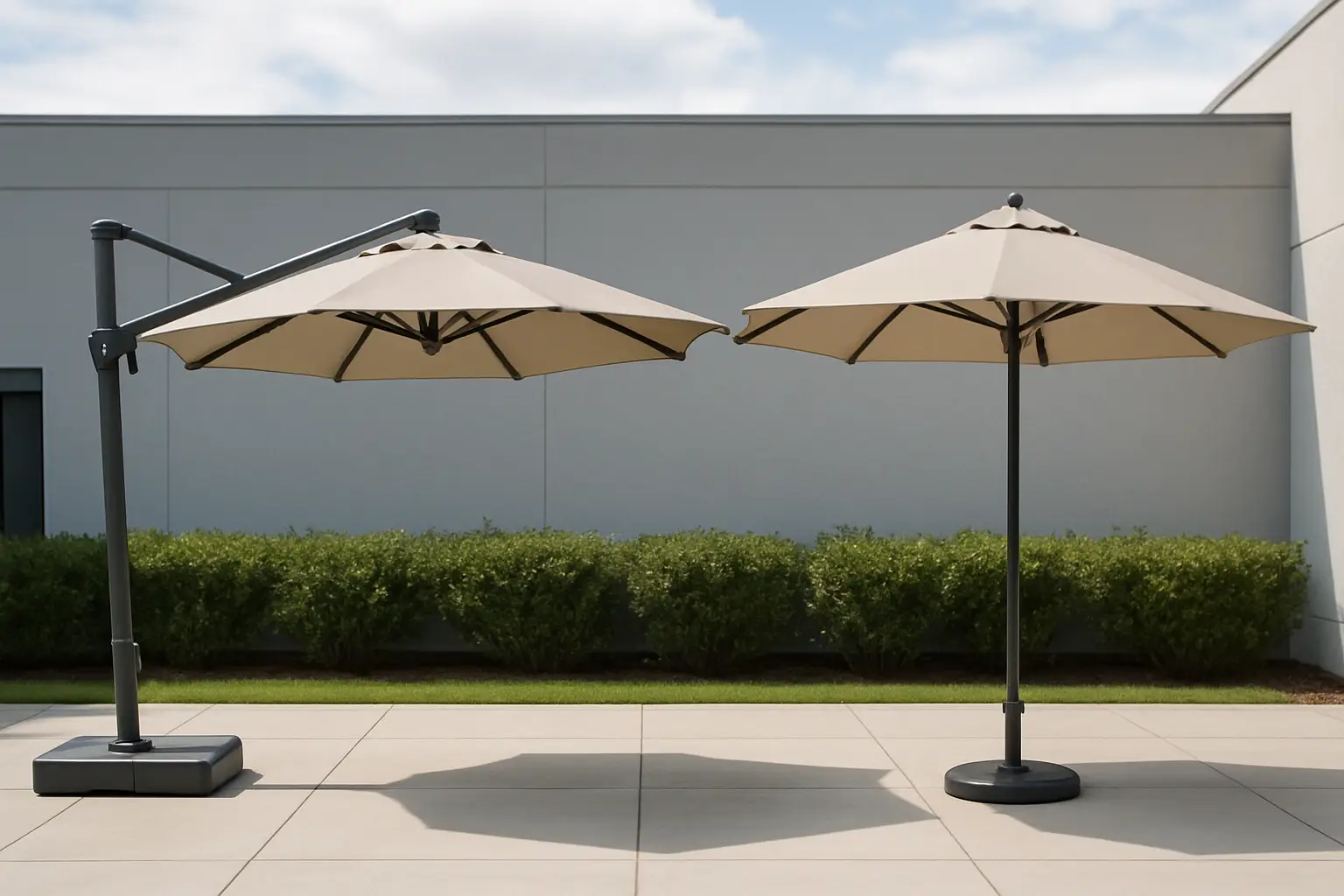
A center pole umbrella is the classic configuration: the mast sits in the middle of the canopy and typically runs through the center of a table or base. It’s straightforward, efficient, and familiar to maintenance teams.
A cantilever umbrella (also called an offset umbrella) relocates the mast to the side and supports the canopy via an arm. You get a clear area under the canopy, but the structure concentrates forces into the side mast and base, which changes how you specify anchoring, clearance, and wind strategy.
The trade-off is simple: center pole umbrellas simplify engineering and cost. Cantilevers simplify usability and furniture planning.
Layout and usable shade: where the pole becomes the problem
If you’re shading a round dining set with a centered opening, a center pole umbrella can be almost invisible in plan and operation. The pole is already where the table expects it, and the canopy’s symmetry maps cleanly to the seating layout.
But projects rarely live in perfect circles. Rectangular dining tables, modular lounge groupings, daybeds, and paired chaise lounges all tend to fight the center pole. The pole lands in leg space, blocks sightlines, or forces furniture to be arranged around an object that wasn’t part of the design intent.
Cantilevers earn their keep when you need shade that behaves like a ceiling plane instead of a column. On pool decks, that matters. Guests move loungers frequently, and a clear footprint under the canopy keeps circulation and reconfiguration easy. On rooftops, it can be the difference between a usable lounge zone and one that always feels cramped.
The constraint with cantilevers is swing and rotation clearance. Many offset designs rotate or tilt to track the sun, which is great – until the canopy sweeps into planters, guardrails, signage, or adjacent seating. If the project is dense, confirm the canopy’s rotation radius and the mast’s placement early, not after finishes are installed.
Base, anchoring, and structural reality
Most procurement issues with umbrellas aren’t the canopy fabric. They’re the base.
Center pole umbrellas generally tolerate smaller bases for the same canopy size because the loads resolve through a central mast. They still need mass and stability, but the physics are forgiving.
Cantilever umbrellas demand more from the base because the canopy is cantilevered away from the mast, creating higher overturning forces. That usually means one of three approaches: a heavy freestanding base, a base designed to accept pavers or ballast, or a hard-mount solution to structure.
If you’re working on elevated decks, podium slabs, or rooftops, the difference becomes a coordination exercise. A heavy base can be a non-starter because of weight limits or waterproofing constraints. Hard-mounting may be ideal, but it requires early alignment with structural engineering, waterproofing details, and access for installation. If that alignment isn’t available, a center pole umbrella can be the safer specification because it can often meet performance needs with less structural negotiation.
Wind performance: specify for the site, not the showroom
Wind is where shade products get expensive. Not at purchase – after replacement, after guest complaints, after a damaged table top, or after a canopy becomes a maintenance burden.
Center pole umbrellas can perform well in wind when properly sized and anchored because their structure is compact and symmetric. They also tend to “fail smaller” in the sense that the load paths are direct and easier to stabilize.
Cantilevers can also be engineered for windy conditions, but the margin for error shrinks. The longer lever arm means gusts produce more torque at the mast and base. In practical terms, that raises the importance of correct base selection, tilt limitations during wind, and clear operational rules for staff.
For hospitality properties, the best wind strategy is often operational: define when umbrellas must be closed, confirm that the closing mechanism is quick, and choose a system that the team will actually use. If the close-down process is awkward or slow, umbrellas stay open longer than they should, and wind becomes a warranty conversation.
Guest experience and staff workflow
Designers love cantilevers because they remove the pole from the center of the experience. Operators appreciate them when they’re stable, easy to adjust, and don’t create bottlenecks.
Center pole umbrellas win on simplicity. Staff know them, parts are familiar, and opening and closing tends to be intuitive. If you’re outfitting many tables across a large terrace, repeating a simple center pole unit reduces training and reduces variation in performance.
Cantilevers win when you need flexible shade throughout the day without moving furniture. If a breakfast area becomes a late-afternoon lounge, or if a pool deck shifts from sunbathing to dining, an offset canopy that rotates or tilts can keep the space working without constant re-sets.
The key question for B2B buyers is not “Which looks better?” It’s “Which one reduces staff intervention?” If the property will rely on hourly adjustments, pick the system with controls that are durable and fast. If the property won’t adjust at all, prioritize a stable fixed strategy with predictable coverage.
Aesthetics and brand standards: symmetry vs intentional asymmetry
Center pole umbrellas read as classic. They align well with traditional hospitality styling, symmetrical table plans, and spaces where the shade element should visually disappear.
Cantilevers read as architectural. They create a deliberate structure in the space, and they often pair well with contemporary lounge programs and modern pool environments.
For multi-site rollouts, consistency matters. Center pole units can be easier to standardize across different footprints because the planning logic is simple. Cantilevers can also be standardized, but only if you control mast placement and rotation clearance in each site plan.
If you’re supplying to villas and private residences, the decision can lean toward aesthetics and flexibility. For restaurants and hotels, the decision tends to be driven by durability, replacement cycles, and the ability to maintain a uniform appearance across a large number of units.
Cost and lifecycle: what you’re really paying for
Unit price is only one line item. Shade is a lifecycle product – fabric fades, mechanisms wear, and hardware sees abuse.
Center pole umbrellas typically deliver lower initial cost for comparable canopy sizes and can be cost-efficient when deployed at scale. They also tend to have simpler mechanisms, which can reduce maintenance time.
Cantilevers often carry a premium because the frame engineering and base requirements are more demanding. That premium can be worth it if it prevents layout compromises, increases seat utilization, or reduces the number of umbrellas needed to cover a zone.
A practical way to evaluate cost is to think in “shaded usable seats,” not just canopy diameter. If a cantilever shades a lounge group cleanly without a pole conflict, it can outperform multiple center pole umbrellas that still leave awkward uncovered corners.
Choosing the right umbrella by application
For dining terraces with many small tables, center pole umbrellas are usually the workhorse choice. They align with table geometry, they’re easy to deploy, and they scale cleanly when you’re furnishing dozens or hundreds of seats.
For communal tables, banquettes, and mixed-use zones where furniture moves, cantilevers reduce friction. You keep the center open, which makes the layout feel intentional rather than improvised.
For pool decks, offset umbrellas often deliver the best guest experience because loungers can be positioned freely. Just be disciplined about base specification and wind procedures.
For rooftops, it depends on structure and wind. If anchoring and weight are constrained, center pole units can be easier to approve. If the rooftop has defined lounge pods with controlled clearances, a well-anchored cantilever can create premium shade without cluttering the footprint.
Specification details that prevent surprises
If you want fewer RFIs and fewer site compromises, treat umbrellas like architectural components, not accessories.
Confirm canopy size relative to furniture, not only in diameter but in how the shade falls at the sun angles that matter for the property’s peak hours. Verify base type and finished footprint, including trip hazards and clearance for lounge chair recline.
Also confirm the operational positions. Some cantilevers cannot be safely left tilted in wind, and some center pole umbrellas cannot clear lighting, heaters, or low pergola beams when opened. These are small details that become real when the first install crew opens 30 umbrellas in one morning.
If you’re coordinating a large outdoor package and want a single supplier who can align shade with lounge and dining layouts, PNZ Space Global supports project planning with shop-ready details and design assistance, which helps keep umbrella placement, bases, and circulation working as a system.
A helpful closing thought: pick the umbrella that makes the space easier to run, not just nicer to render – because the most successful outdoor areas are the ones your operations team can keep perfect on a busy day.
