
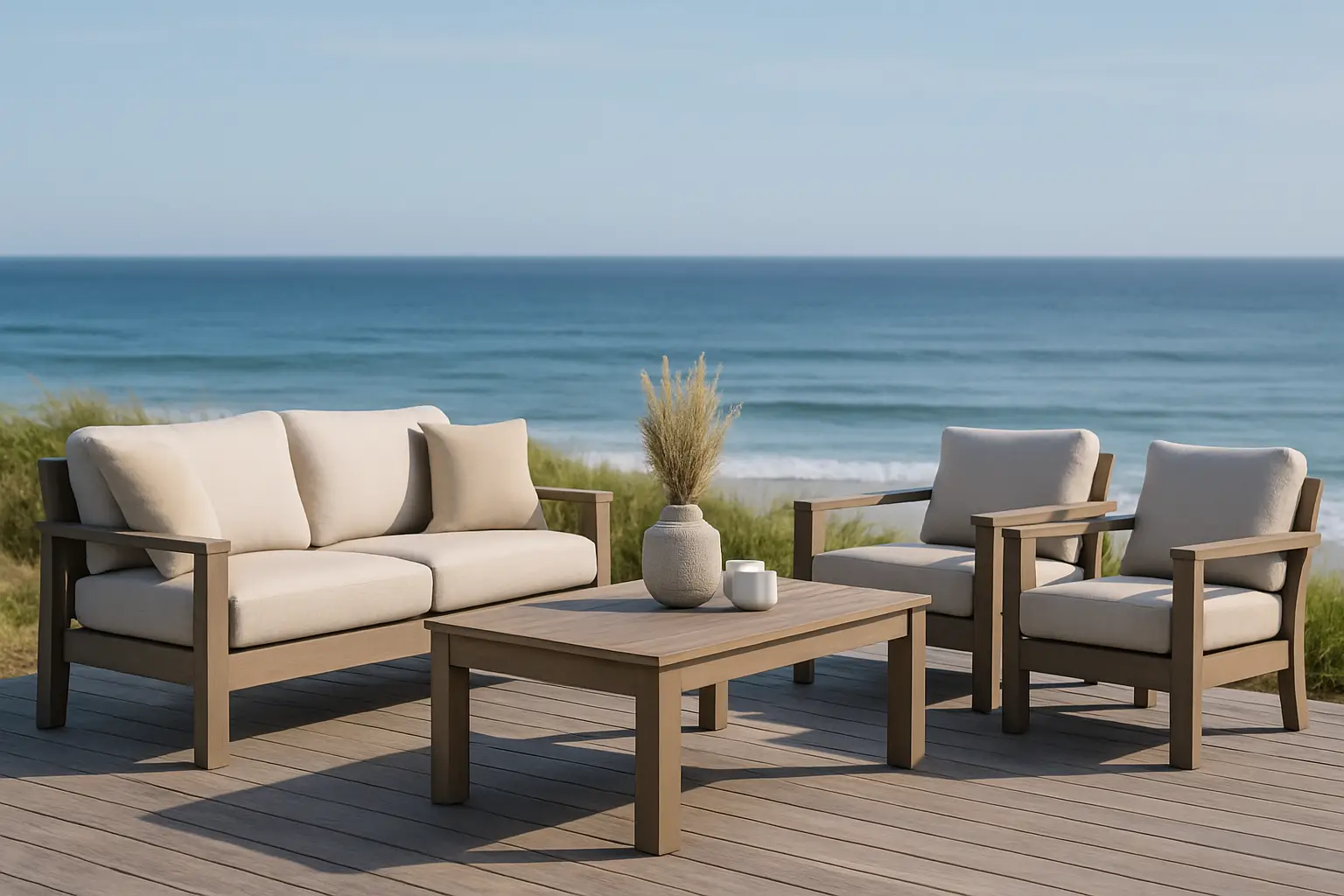
Salt air doesn’t ruin outdoor furniture slowly. It ruins it on a schedule.
If you manage a beachfront hotel terrace, a rooftop in a marine layer, or a villa pool deck a few blocks from the water, you have seen the pattern: hardware blooms with corrosion, powder coats chalk, teak looks uneven, cushions stay damp longer than they should, and suddenly a “premium” setting starts reading as neglected. Coastal environments punish every weak link in the spec – and they do it while guests are sitting right there.
This guide is written for buyers who spec at scale: designers, architects, developers, procurement teams, and hospitality operators. The goal is not to romanticize “beach style.” It’s to get you to the best outdoor furniture for coastal climates by making sure your materials, finishes, and construction details match the real conditions on site.
What coastal climates do to outdoor furniture
Coastal wear is a combination of salt, UV exposure, wind abrasion, and humidity. Salt accelerates corrosion on metals and creates deposits that scratch finishes when wiped improperly. UV breaks down polymers and fades fabric dyes. Humidity slows drying and can drive mildew in cushions and sling materials, especially in shaded or tightly arranged layouts.
The operational impact matters as much as the technical one. A coastal project that looks great on day one but needs constant touch-ups becomes a maintenance budget problem and a brand problem. That is why coastal specification is less about a single “best material” and more about choosing systems that stay stable when housekeeping, weather, and guest use are all hitting the product at the same time.
The best outdoor furniture for coastal climates starts with the frame
Frames take the structural load and they determine how quickly corrosion or finish failure becomes visible. In coastal projects, frame selection is the first gate.
Marine-grade aluminum (powder coated)
For most hospitality and multi-unit outdoor environments, aluminum is the safest default. It does not rust, it is light enough for staff to move, and it scales well across a full outdoor program (dining, lounge, pool, bar).
Where coastal projects go wrong is not “aluminum vs. not aluminum.” It’s finish quality and pretreatment. Specify powder coating that is UV-stable and applied over proper pretreatment for adhesion and corrosion resistance. Also pay attention to weld quality and drainage paths inside tubular frames. Trapped moisture inside a tube can create staining at joints even when the outer finish looks intact.
Trade-off: aluminum can show impact dents more than thicker steel. In high-traffic venues, choose profiles that balance clean lines with enough wall thickness to avoid a “soft” feel.
Stainless steel (but choose the right grade)
Stainless is appealing for its weight and architectural look, especially on premium rooftops and waterfront dining. In coastal air, not all stainless performs equally. If your project is truly near breaking surf or exposed to sea spray, you want marine-grade stainless and you still want a cleaning protocol. Stainless can tea-stain – a surface discoloration – when chlorides sit on it.
Trade-off: stainless costs more and fingerprints, water spots, and salt deposits can be more visible. If your operations team will not commit to routine rinsing and wipe-downs, stainless may create more visible upkeep than aluminum.
Avoid ordinary carbon steel outdoors near the coast
Even “outdoor” steel with a powder coat is a risk when salt is present. Once the coating gets a chip, corrosion starts at the breach and can creep under the finish. In coastal settings, that timeline is short.
If a concept demands steel, build a full system around it: corrosion-resistant coatings, sealed joints, and an expectation of touch-up. For most procurement teams, it is simpler to get the same visual weight through aluminum profiles or mixed materials.
Finishes and hardware: the small parts that fail first
Coastal projects often fail at fasteners, not frames. A chair can look fine until screws rust, wobble, and seize.
Spec corrosion-resistant hardware and be consistent across the bill of materials. Mixing metals creates galvanic corrosion risk – especially if dissimilar metals are in contact and moisture is present. Also consider how the furniture will be serviced. If a design hides fasteners but makes them inaccessible, field repairs become slower and more expensive.
For powder-coated products, insist on smooth coverage at welds and corners, where coatings can thin out. For touch points like arm caps and table edges, choose finishes that can handle frequent cleaning without softening or dulling.
The coastal material short list (what actually works)
No single material wins in every coastal scenario. The best outdoor furniture for coastal climates is usually a smart combination: a stable frame, a UV-resistant surface, and textiles that dry fast.
Teak and other durable hardwoods
Teak remains a strong choice for coastal lounges and dining because it handles moisture swings well and can be refreshed. It will weather to a silver-gray if left untreated, which many clients like, but uneven exposure can create patchy tones. For hospitality, decide early whether you want the weathered look or a maintained oiled finish, then plan labor accordingly.
Trade-off: wood is not “set and forget.” It needs routine cleaning, and if you oil it, you are committing to a schedule.
Synthetic wicker (HDPE) over aluminum
For resort styling, high-quality HDPE woven over aluminum frames performs well. It resists UV better than lower-grade plastics and it is comfortable without heavy upholstery.
Trade-off: weave color can still fade over time in high UV, and sand can collect in the texture. Choose weave density and color with cleaning realities in mind.
High-pressure laminate (HPL) and quality outdoor table tops
For dining and café environments, specify table tops that resist UV, staining, and moisture. HPL is widely used in contract settings because it’s consistent and relatively low maintenance.
Trade-off: edges matter. Poor edge sealing is where moisture ingress starts. Also consider the table base – a coastal top on a weak base still fails the project.
Concrete and stone composites (use carefully)
Concrete-look tables and side tables can be excellent for wind exposure because of their mass. In salt air, the concern is sealing and stain resistance, plus the logistics of moving and installing heavy pieces.
Trade-off: weight is both a benefit and a constraint. If your layout changes often, heavy pieces may increase labor and floor wear.
Cushions and upholstery: quick-dry is not optional
In coastal climates, cushions are either engineered to dry fast or they become a liability. Spec solution-dyed acrylic or comparable performance fabrics with strong UV resistance. Pair that with quick-dry foam or reticulated foam, and make sure cushion construction supports drainage.
Zippers and threads are not minor details. If zipper coils corrode or thread degrades, you lose covers and the cushion core becomes exposed. For hospitality, removable covers matter because they reduce replacement cost – but only if the covers are built to survive repeated laundering and reinstallation.
Trade-off: the fastest-drying cushion systems can feel firmer. For luxury lounges, balance guest comfort with drying speed by choosing the right foam density and construction rather than defaulting to thick, slow-drying fills.
Category-by-category coastal picks (how buyers actually specify)
Procurement rarely buys “a chair.” You are building zones: dining capacity, lounge clusters, poolside turnover, and shade.
Lounge seating for coastal terraces
Prioritize aluminum frames with performance straps or sling backs where possible, especially in humid areas. This reduces reliance on thick cushions and shortens drying time after fog or sea spray. If you want fully upholstered lounge depth, make quick-dry cushions non-negotiable and choose fabrics that hide sunscreen residue and salt spotting.
Modular sectionals can work near the coast, but they need connectors and feet that resist corrosion. Also plan for wind: lighter modular units should be weighted or designed to interlock securely.
Dining sets for beachfront and rooftop F&B
Dining furniture takes the most handling. Stackability helps operations, but stack points can scratch finishes if not designed well. Choose dining chairs with replaceable glides and frames that handle frequent movement.
For table bases, aluminum is often the most forgiving option. If you choose stainless for the look, coordinate cleaning standards with the operator so salt deposits don’t become a daily visual issue.
Poolside furniture (chlorine plus salt is a real combo)
Pool decks add chemical exposure on top of coastal conditions. Sling chaise lounges and strap systems perform well because they dry quickly and reduce soft goods inventory. If you prefer cushioned chaises, specify cushion systems that can be stood on end to drain and dry.
Also consider surface temperatures. Dark finishes and dense tops can heat up in direct sun. Lighter colors and heat-aware materials improve guest comfort and reduce complaints.
Shade solutions and accessories
Coastal wind is where shade products either prove themselves or become a safety problem. Specify umbrellas and shade structures with wind ratings appropriate for the site and base weights that match your exposure. Hardware and internal ribs need the same corrosion-resistant mindset as furniture frames.
Accessories like side tables, carts, and planters are worth specifying with the same discipline. These items get overlooked, but they often fail first because they are moved constantly and cleaned aggressively.
What to ask your supplier before you place a coastal PO
Coastal procurement succeeds when you treat furniture like a system with accountable specs. Ask how frames are welded and finished, what hardware is used, and how cushions are built for drainage and UV.
You also want a supplier that can support approvals and consistency across large orders. For multi-site rollouts or hospitality openings, request finish samples, fabric swatches, and mock-ups early so your stakeholders approve once and you avoid last-minute substitutions that compromise performance.
If you are furnishing at project scale and want a single partner to coordinate outdoor categories with drawings, mock-up approvals, and logistics, PNZ Space Global can support that end-to-end through its vertically integrated manufacturing and project services at https://www.pnzdesign.com.
A simple way to make the right choice on coastal projects
When you are deciding between two attractive options, don’t let the showroom moment be the tiebreaker. Let your worst day be the tiebreaker: a windy week, high occupancy, sunscreen everywhere, salt residue on every horizontal surface, and a short turnaround before the next check-in.
Spec furniture that still looks intentional on that day, not just on delivery day – and your coastal outdoor areas will keep earning their square footage.
